Human trafficking is a pervasive, widespread crime.
It has been reported in all 50 U.S. states, in D.C., on Tribal land, and within U.S. territories. Trafficking takes place in hotels and at bus stops; victims are groomed on social media and dating apps.
The first step in combating an issue as widespread as this one is simple: awareness.
We Are Louder is a social-purpose company that fights human trafficking by making sure individuals and organizations have the knowledge they need to recognize and respond to trafficking when they see it.
Meet We Are Louder
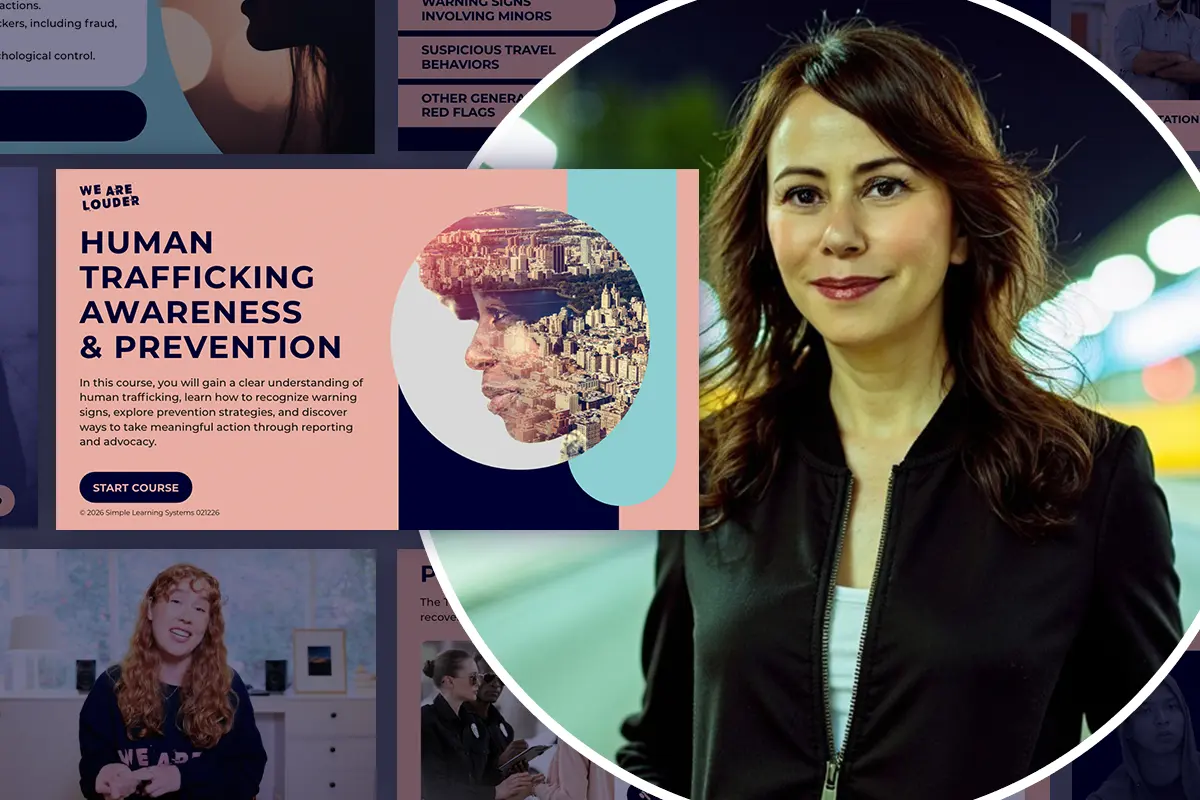
We Are Louder collaborated with Mandated Reporter Training to create the National Human Trafficking Awareness and Prevention Training. They work to make sure community members have the knowledge they need to spot the signs of human trafficking and take action.
Learn more about their vital work to keep communities safe in this interview with We Are Louder co-founder Michelle Ryan.
Q: What inspired the creation of We Are Louder?
A: I’ve always believed in the power of communities to create real, lasting change. And protecting children has always felt urgent to me. They are our most vulnerable and our greatest hope. Change depends on them.
Child trafficking is one of the greatest atrocities we face, and I knew I wanted to focus on prevention. If we can educate communities before exploitation happens, we can protect kids before they ever become victims. Entertainment, music and film, was always part of the vision because that’s how you move people at scale. But working alongside the Mandated Reporter Training team made it clear that education had to come first. Awareness is the foundation everything else is built on.
Q: What Does We Are Louder Mean?
A: The name comes from a track written and produced by our co-founder Jamie Way, a tremendously talented music producer and writer. When we first launched We Are Louder, we were working with musicians to fight child trafficking, and Jamie wrote and produced a track called “We Are Louder Than Them” featuring Gift of Gab from Blackalicious and Zumbi of Zion I. The track was fire and it represented our mission perfectly.
But the name means something deeper than the song. We believe there is quiet strength in each of us. When communities unite around a cause, that strength grows. It starts as whispers rippling through crowds, and with time and momentum it becomes an undeniable roar, one that demands freedom, dignity, and equality for all. Human traffickers operate in silence and shadows. They depend on people looking away. We are louder than that silence. And we will keep growing louder until every child is safe.
Working With We Are Louder to Create the National Human Trafficking Awareness & Prevention Training
A deep belief in the power of education to fight back against the crime of trafficking led We Are Louder to collaborate with Mandated Reporter Training. The result of that partnership was a National Human Trafficking Awareness training designed to equip all of us with the tools to recognize the signs of trafficking. This is especially important for professionals in positions to spot these red flags early, such as those in hospitality, transportation, retail, healthcare, social work, or law enforcement.
Q: What is your goal in creating the Human Trafficking Awareness & Prevention Training?
A: Knowledge is empowerment. That’s at the heart of everything we do. If communities feel equipped to protect their own, the impact is massive, and it multiplies. When people know what trafficking actually looks like, they rise up. They report. They intervene. They protect.
But the goal that moves me most is prevention. If parents know the signs, they can have the right conversations with their children. If young people learn the tactics traffickers use, they are harder to manipulate and exploit. That’s a child who never becomes a victim in the first place. That’s what we’re working toward.
The training is the foundation.
Training Guided By Lived Experience & Professional Expertise
As a learner, this training will help build your confidence in recognizing the red flags of human trafficking, the distinction between labor and sex trafficking, and survivor-centered advocacy and prevention strategies.
You’ll learn from advocates who fight passionately against human trafficking.

Those voices include:
Regina Evans: Artist and Abolitionist
An award-winning social justice playwright, actor, abolitionist, costume designer, and installation artist. She founded Regina’s Door in Oakland, an acclaimed vintage boutique and creative arts space dedicated to the healing of young survivors of sex trafficking, and co-founded Beloved: An Insistence, a healing arts street outreach to youth being trafficked.
Regina has served as a Delegate and Speaker at the UN Commission on the Status of Women, has received the 2020 Modern-Day Abolitionist Award, and is a Jefferson Award winner.
Her voice in this training carries the weight of someone who has looked this crisis in the eye and responded with art, love, and action.
Rashida Chase: Artist and Cultural Strategist
An Oakland-based vocalist, cultural strategist, and community advocate whose work sits at the intersection of art and urban development. She serves as a Cultural Strategist for the City of Oakland and is the founder of Liberated Culture, a cultural enterprise focused on strategic consulting and community building.
Rashida led the state designation process for the Black Arts Movement and Business District and has spent her career ensuring that communities most vulnerable to exploitation are also the ones most supported and celebrated.
Her perspective brings the community prevention angle to life in a way that data alone never could.
Kendall Anderson: Community Human Trafficking Advocate
A systems-based Victim Advocate with deep expertise in direct services for survivors of human trafficking and domestic violence. She holds a Master’s in Urban and Public Affairs from the University of San Francisco and a Bachelor’s in Political, Legal, and Economic Analysis from Mills College.
During graduate school, Kendall served as a Human Trafficking Fellow at the San Francisco Department on the Status of Women, and her academic research focused on human trafficking interventions, including a thesis examining SFO’s bathroom-sticker initiative and its effect on public awareness.
Kendall brings the policy, systems, and survivor advocacy perspective that grounds the training in real-world response.
What You Can Do
Q: What would you like learners to know about We Are Louder and the training?
A: Protecting the vulnerable is not someone else’s responsibility. It is everyone’s. Human trafficking thrives in communities where people look away, where they assume it’s someone else’s problem, or where they simply don’t know what to look for. We Are Louder exists to change that.
The training is a starting point, not a finish line.
Children are being exploited right now, in cities and neighborhoods across this country, often in plain sight.
We are louder than the silence that allows this to continue. And we need you to be too.
Q: What’s next for We Are Louder?
A: We’re also developing a film series that shows what trafficking looks like from multiple perspectives, much like how Mandated Reporter Training is tailored by profession and state. Our films will be grounded in real locations like Oakland, New York City, and Washington, D.C., and will follow different professions: teachers, medical professionals, law enforcement, and more. Because trafficking looks different depending on where you are and what you do, and people connect most deeply with stories that reflect their own world.
We are actively seeking funding for our film series. If you are an individual, organization, or funder who believes in the power of storytelling to drive social change, we would love to connect.

Support We Are Louder by Spreading Awareness
Looking for more ways to support We Are Louder in the fight against human trafficking?
Start by spreading awareness. Share resources with your network, your neighbors, your community. This can look like:
- Inviting others to take the training
- Advocating for resources like the National Human Trafficking Hotline
- Raising awareness for organizations like We Are Louder
If you have children, encourage them to be vigilant with their peers at home, online, and in their social circles.

If you suspect human trafficking, contact the National Human Trafficking Hotline.
1-888-373-7888
Text 233733 (BEFREE)
Help is confidential and available 24/7.