She is fifteen.
She has lived in four placements in the last two years. She has run from her current home twice already. The first time, a caseworker found her at a bus station. The second time, she came back on her own after three nights of sleeping in a park.
There is a man who has been talking to her online for about a month. He is older. He tells her she is beautiful and mature for her age. He tells her the resource family does not understand her the way he does. He says he has a friend with an extra room and no rules, a place where she can stay as long as she wants. He says he wants to give her nice things.
The night she runs for the third time, he is waiting in a car around the corner. For the first week, he gives her everything he promised. Clothes, a phone, and a sense that she is wanted.
In the second week, he tells her about the favor.
It is small, he says. Just one thing, to help with rent. Just this once.
The Person Traffickers Look For First
Traffickers do not look for victims at random.
They look for the children whose case files are thick and whose support systems are thin. Foster youth, runaways, unhoused teenagers, people with histories of abuse, and teens who feel misunderstood and unsupported. Young adults aging out of care with nowhere to go.
The data is clear about who is most at risk. The National Center for Missing & Exploited Children reported that in 2025, of the more than 32,000 reports of missing children to NCMEC, 1 in 7 missing children were likely victims of child sex trafficking.
In 2024, NCMEC assisted with 23,160 reports of children missing from foster or state care, and the federal Administration for Children and Families has explicitly named departures from care as a driver of trafficking risk, noting that children in care may leave without permission, and such departures increase their risk of trafficking and exploitation.
While any child can be targeted by a trafficker, research, data, and survivor experience have revealed that traffickers often target youth who lack strong support networks, have experienced violence in the past, are experiencing homelessness, or are marginalized by society.
When youth feel like they are not loved, supported, or like they don’t belong, they become ever more vulnerable to unsafe situations.
Traffickers are masters of manipulation and prey upon vulnerabilities using psychological pressure, false promises, actions of perceived love/support, and intimidation to manipulate, control, and exploit a victim for their benefit.
Traffickers offer perceived love, support, and belonging. To someone who has spent years being moved, ignored, hurt, or overlooked, those offers do not look like a trap. They look like the answer.
The Harm Trafficking Leaves Behind
Trafficking affects children and adults. It happens to women, men, and gender-diverse people.
Trafficking takes the form of forced commercial sex and the form of forced labor in fields, factories, restaurants, hotels, construction sites, nail salons, private homes, and online platforms. Its victims include US citizens and noncitizens, English speakers and non-English speakers, people born into poverty and people who have stable lives.
The harm trafficking causes does not end when a victim escapes. A 2022 Polaris study of sex and labor trafficking survivors found that 96% had experienced physical, sexual, or emotional abuse, 91% experienced mental health challenges, 83% experienced poverty, and 62% experienced substance abuse.
Survivors carry physical injuries, complex trauma, lost years of education and earnings, severed family relationships, and debt that traffickers used to control them and that follows them long after the trafficking ends.
The damage is not contained to the victim. Trafficking pulls children out of school, workers out of legitimate labor markets, and family members into the gravity of someone else’s exploitation. It corrodes the institutions that should have caught what was happening.
Could You Recognize the Signs of Trafficking?
Trafficking has been reported in every US state and territory and across urban, rural, and tribal areas.
The Global Slavery Index estimates that approximately 1,091,000 people are living in conditions of modern slavery in the United States, a rate of 3.3 victims per 1,000 residents.
If trafficking is happening in your neighborhood, in your child’s school, at the restaurant where you eat lunch, at a local hotel, or in the home down the street, would you know what to look for?
Would you know how to spot the signs that a coworker, patient, student, neighbor, or a stranger is being controlled by someone else?
Would you know what to do, who to call, and how to act to protect the victim rather than put them in greater danger?
Most people would not. The signs of trafficking are specific and learnable, yet they are unfamiliar to almost everyone who has not been trained to recognize them.
Human Trafficking Awareness & Prevention Training
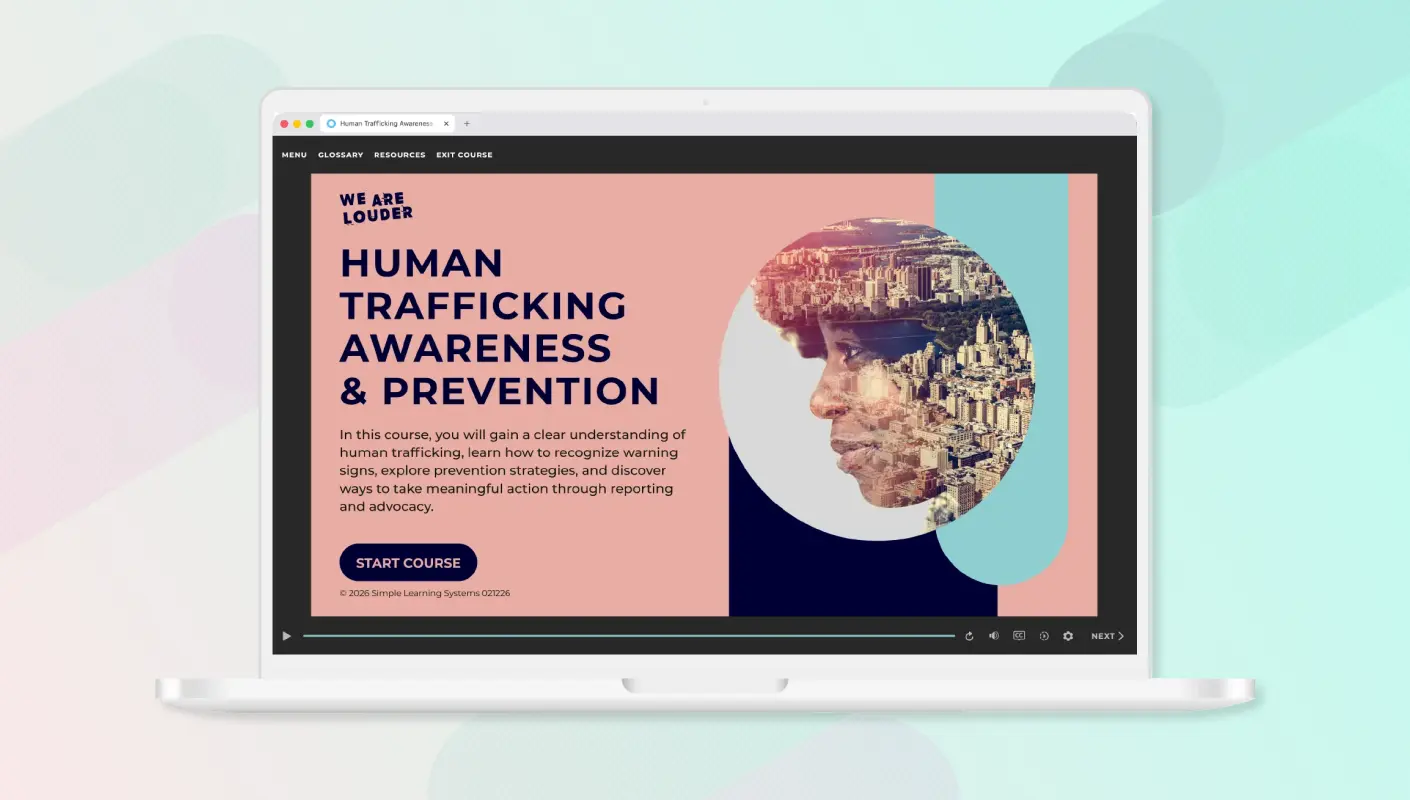
Human Trafficking Awareness & Prevention Training is a new course available on the Mandated Reporter Training platform.
This online course takes about 80 minutes to complete and is designed to help you understand the risks and signs of trafficking.
The course covers six lessons:
- The legal definitions that distinguish trafficking from other forms of exploitation, including the federal protection that classifies any minor involved in commercial sex as a trafficking victim, regardless of force, fraud, or coercion.
- The types of trafficking and the environments where it occurs, from private homes to legitimate businesses.
- How to recognize the indicators of labor and sex trafficking in the people you encounter.
- The methods traffickers use to recruit, groom, and control victims, including digital tactics that target children through social media, gaming platforms, and messaging apps.
- What to do when you suspect trafficking, including industry-specific guidance and the appropriate reporting pathways.
Why Take Human Trafficking Training?
Trafficking does not look like the abuse categories most adults are trained to recognize. This training teaches specific patterns so you can recognize them when they appear.
In this online training, you’ll learn how traffickers actually operate:
For example, stranger abductions are rare; grooming is common.
Most trafficking begins with a relationship the victim believes is real, an offer that looks like an opportunity, and a slow erosion of every other option.
Understanding the method makes the early warning signs visible before a vulnerable person disappears entirely into the situation.
You’ll also learn what to do next when you recognize the signs of trafficking in your community, and how to report in a way that protects a vulnerable person rather than putting them at risk.
Human Trafficking Awareness & Prevention Training was created in partnership with We Are Louder, a social purpose company dedicated to building a network of informed individuals who can recognize exploitation and take responsible action. Through structured, accessible training, We Are Louder provides education on trafficking indicators, recruitment tactics, vulnerable populations, and safe response protocols.
“The most powerful tool against trafficking isn’t legislation or law enforcement — it’s an informed community that knows what to look for and isn’t afraid to act.”
— Michelle Ryan, Co-Founder, We Are Louder
The Human Trafficking Awareness & Prevention Training is now available on the Mandated Reporter Training platform. Log in today and start training.